
Supporting Independence and Peace of Mind Through Every Stage of Alzheimer’s Care

Family caregivers of a loved one with Alzheimer’s disease face a challenge that continually changes: providing enough support to keep someone safe without unnecessarily taking away independence. Early in the disease, that may mean reminders and occasional check-ins. Later, disorientation, wandering, falls, and increasing personal-care needs can make closer supervision essential.
The most sustainable approach is not to create one permanent caregiving system. It is to build a plan that changes as Alzheimer’s progresses, adding safety technology, routines, family coordination, and professional support when they become appropriate. The Alzheimer’s Association describes caregiving responsibilities as changing substantially from early-stage support to increasingly intensive care in later stages.
What Caregivers Need to Know
Alzheimer’s caregiving works best as an evolving safety plan. The goal is to preserve independence while it remains safe, recognize new risks early, and increase support without waiting for a crisis.
For many families, that means:
- Early stage: emphasize independence, predictable routines, reminders, scheduled check-ins, and planning for future needs. A medical alert system with a daily check-in call, like ours, can add a friendly, consistent touchpoint without taking over.
- Middle stage: increase supervision and consider location technology, medical alert protection, fall detection, and safeguards for wandering. Our On-The-Go systems with GPS, along with our caregiver tools, can help families respond sooner when something changes.
- Late stage: prioritize comfort, intensive assistance, care coordination, and clear communication among relatives and healthcare providers. A medical alert system can continue to provide an emergency pathway alongside in-person caregivers.
No technology eliminates risk. Used thoughtfully, however, technology can become another layer in a broader caregiving plan.
How Safety Needs Change With Alzheimer’s
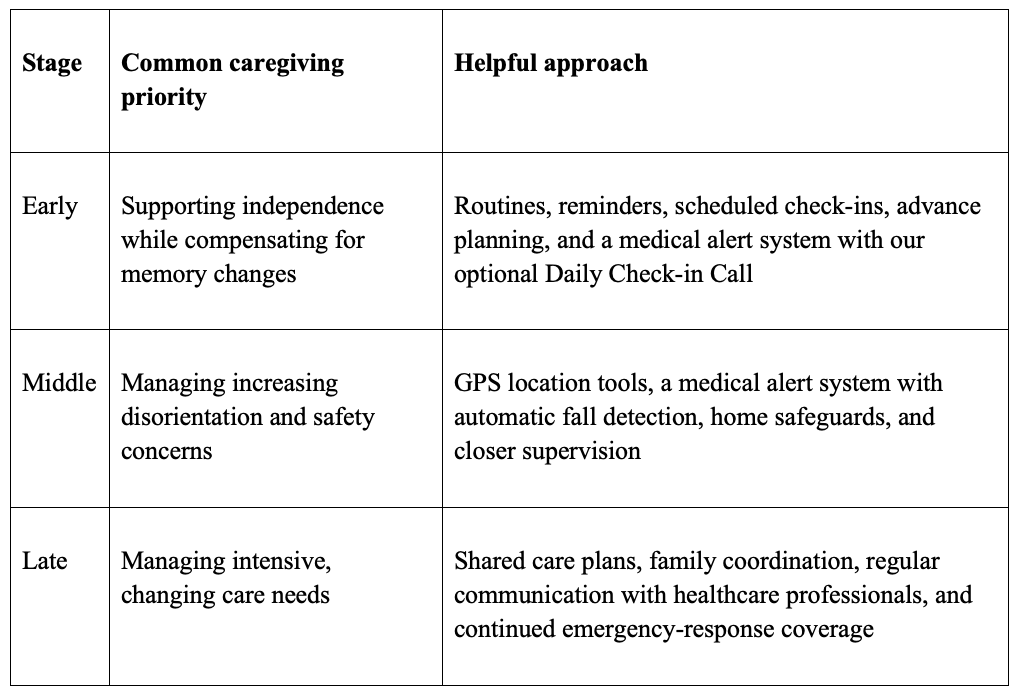
These transitions are not identical for every person. Still, the overall direction matters: as abilities change, yesterday’s safety plan may no longer be enough. In the middle stages, for example, routines generally require adaptation and greater structure; late-stage Alzheimer’s commonly requires intensive, around-the-clock care.
When Wandering Changes the Safety Equation
Wandering deserves particular attention because a person with dementia may become lost even in previously familiar surroundings. Six in 10 people living with dementia will wander at least once, so planning ahead rather than waiting for an incident is crucial.
This is where an on-the-go medical alert device with GPS can become especially useful, for the person wearing it and for the people who care about them. The wearer can press a button to reach our 24/7 U.S.-based care agents, and optional automatic fall detection can request help even if they cannot press the button. Caregivers gain location information that can help them respond when someone becomes disoriented. With our Safe Watch Active® and VIP Active®, approved caregivers can request a location by text message, with no app required. With our VIPx2®, the optional Caregiver Mobile App adds on-demand location and Virtual Boundary alerts that notify caregivers when the wearer enters or leaves areas they have set. You can learn more about our caregiver tools and how they work. Because someone with Alzheimer’s may forget to press a button or take a device off, it also helps to build wearing and charging the device into the daily routine.
A Practical Safety-Plan Checkup
As needs change, caregivers can periodically work through this simple process:
- Review current abilities. Identify what your loved one can still safely manage alone.
- Look for emerging risks. Pay particular attention to falls, getting lost, medication difficulties, nighttime activity, and increasing confusion.
- Add support proportionately. Introduce monitoring, medical alert protection, GPS location technology, or additional supervision when the risk warrants it. For many families, this is the point to choose a system like ours, set up emergency care instructions so our agents know who to call, and add the caregiver tools that fit your situation.
- Update the routine. Keep meals, sleep, activities, appointments, and other daily events reasonably predictable. Structured daily plans can reduce the burden of constantly deciding what happens next.
- Share the plan. Make sure relatives and care providers know important routines, medications, contacts, responsibilities, and recent changes, including who receives alerts or location requests and what each person should do when one comes in.
Making Long Medical Documents Easier to Navigate
Caregivers may also find themselves managing neurologist reports, medication information, treatment guidance, and lengthy care documents. An AI pdf chat tool can help a caregiver upload documents and ask plain-language questions about the material, making it easier to locate information about a medication, care recommendation, or warning sign without repeatedly searching page by page. Adobe says its PDF chat service can answer questions, compare documents, and extract information from uploaded files. For medical decisions, important information surfaced by any AI tool should still be confirmed with the appropriate healthcare professional.
How Our Medical Alert Systems Support Alzheimer’s Caregivers
LifeFone has been in business since 1976, and we offer At-Home and On-The-Go medical alert systems, including options with automatic fall detection and GPS-enabled location technology. Our goal is to help a loved one with Alzheimer’s keep as much independence as is safe, while giving the family another layer of protection.
How it helps the person wearing it: Help is a button press away at any hour, whether they are at home or out and about, and our 24/7 U.S.-based care agents are there to respond. Optional automatic fall detection can request help even if the person cannot press the button, which matters when memory loss or confusion makes it hard to follow an emergency routine. We can also place a daily check-in or reminder call, so your loved one hears a friendly, familiar voice each day.
How it helps caregivers: Our caregiver tools are designed to give families information and shared responsibility, so they are not relying on repeated phone calls to know their loved one is safe. With Safe Watch Active® or VIP Active®, approved caregivers can request the wearer’s location by text message with no app required. VIPx2® subscribers can add our optional Caregiver Mobile App, which can give approved users on-demand location, device battery notifications, button-press history, step tracking, first-motion-of-the-day monitoring, and Virtual Boundary alerts from a mobile device. The Caregiver Mobile App is not a standalone product; it is only available with the VIPx2® device.
We also offer a 30-day money-back guarantee and a lifetime subscriber price and equipment guarantee. Family caregivers can call us at 1-800-331-9198 to choose a medical alert system suited to supporting independence for a loved one with Alzheimer’s while providing greater peace of mind for the family.
One Resource Worth Keeping Close
The Alzheimer’s Association caregiver resources provide practical guidance covering disease stages, daily care, safety, care options, planning, and caregiver support. Because needs evolve, returning to a reliable resource over time can be more useful than treating caregiving education as something completed immediately after diagnosis.
Frequently Asked Question
When should a family reconsider an Alzheimer’s caregiving plan?
Reassess the plan whenever abilities, behavior, mobility, orientation, or care needs noticeably change. A new wandering episode, fall, difficulty navigating familiar places, or increasing dependence with daily activities can signal that additional safeguards or supervision should be discussed. Care plans should evolve because the person’s needs evolve; regular communication among family members and care providers helps keep everyone working from the same information.
Planning for the Next Stage, Not Just Today
Good Alzheimer’s caregiving is adaptive. A light-touch system that protects independence today may eventually need to become a more coordinated network of technology, family members, and professional care. Most importantly, safety and independence do not have to be opposing goals, and they can be continually rebalanced as a loved one’s needs change.
FREE BROCHURE Today!